Showing posts with label techniques. Show all posts

Reference Photos: Unknown Western Saddle


Yesterday I mentioned my garage sale find of the year: a western saddle for $25. I can't locate a makers mark, but it seems pretty sound. I'll actually be using it for a swing (any interest in a blog post documenting that progress?) but I took the time to snap some photos for anyone who doesn't have one handy or previous experience with western tack.

No matter how much of a Google guru you are, it can be hard to find photos of certain things, like the way the swells are covered and how it's cut for the horn.

Or the shape of the seat...


Or the underside of the fork!


I'm probably a bit biased, but I think the tooling on this saddle is really pretty.


There are more photos of the entire saddle in the Picasa album (click to follow). I tried to cover everything I could think of that might help, but if there's a particular part you'd like to see, let me know!


It's a Wrap!

The set isn't quite finished. Almost, anyway. But that's not what this wrap is about.

It's about Saran Wrap. Or plastic wrap, if you buy the store brand like I do. Or Evil Forcefield of Staticky Doom if it hates you has much as it hates me.  It sticks to my hands, the counter, the box, itself, and everything but the dish I'm trying to cover.  But I digress.


It's very hand stuff for fitting; protects the model from dye and miscellaneous gunk without creating a lot of extra bulk.  This idea is not mine, lest you think me brilliant or some such nonsense.  Jennifer Buxton and Leah of Shoestring both use plastic wrap to protect ponies while working on various projects.

This lovely Jezebel, resculpted by Mel Miller, is not mine.  Alas and alack.  Let me go weep in the corner for a moment, because she's really lovely and I'm not even an 'Arab person.'

. . .

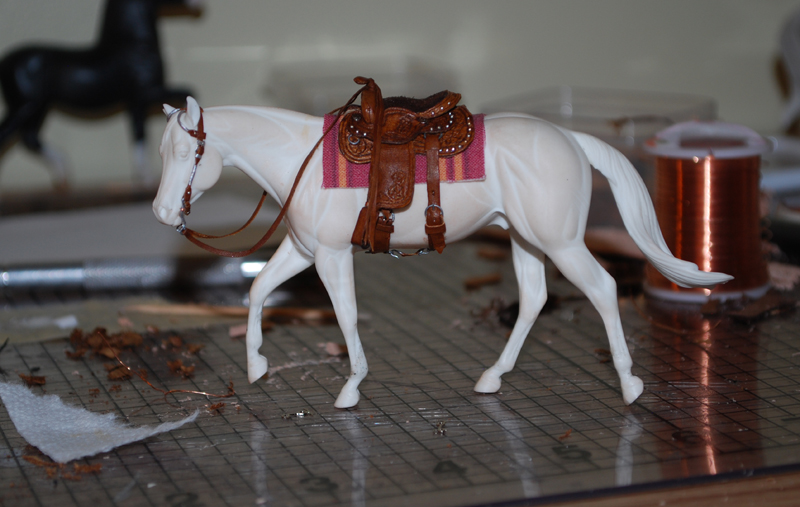
Okay. Back. If she were mine, I'd skip this step entirely.  Blank resins are not sacred in this studio.  No paint means no problem - I fit directly to the model, wet dye or sealer be darned. WeeJay especially has some epic dye 'sweat' marks, but is tacked up right now (AND my card reader decided to be finicky).

But Jezebel is not mine, and so a great deal of care has been taken with her.  When not in use, she hangs out on a piece of felt on her side, well out of the general carnage.  And when it comes time to fit her saddle, she gets a plastic wrap poncho for protection.


Because I have such bad luck with plastic wrap actually sticking to the desired places, I secured this with a piece of scotch tape under the belly.  It's taped to the plastic wrap, not the pony. The plastic covers more than necessary, actually, since this is just to fit the saddle, but covering the neck and croup helps keep everything in place.

I cover the saddle with sealer top and bottom and then twist tie it down gently.  Too hard and you'll get funky lines across the leather - no bueno. The sealer has two purposes - extra protection for pony down the line and it makes the leather damp, which helps accelerate the shaping process and keeps the saddle in shape after it dries.  Water would accomplish the same purpose, but I like having more than one coat of sealer on a project.  For most of the saddle, this is a second coat. I can be a little flaky with sealing after dyeing and before construction, especially if I'm in a hurry, need just a little bit of this color, or whatever.  That, and the fact that I paint on the studs that go on the jockeys near the pommel, is why I always always seal EVERYTHING at least one more time after I have finished constructing the saddle.


While training the saddle, I do not apply sealer to the stirrup leathers.  I'll do that after it comes off the horse. The stirrup bars (or what would be stirrup bars) are usually covered by the twist tie and cause the stirrup leathers to dry funny.  It's easier for me to do those after the twist tie comes off rather than fighting them.

And viola! Nicely trained saddle, clean pony, win win.


If anyone's counting...10 days until class starts.  Think I can finish this in time?

The Easy Way, Part II

I haven't had the time to make a proper light tent, and my makeshift attempts have all failed miserably.  The light is too warm, too dark, the results too contrasty, the backgrounds horrible.  I am also not a patient (or neat) person (which in hindsight is one of the reasons I make tack this small, I think), so the time it takes to get the tent out, set up the lights, set up the background, take the photos, deal with stickywax that starts to smear under the effects of three or four 65 watt bulbs, and other general problems is not my idea of time well spent.

So I do it the easy way.


When you are photographing to sell, less is more.  A neutral, uncluttered background is best.  The step is deep enough that I can move my horse far enough from the edge to get the wood grain out of focus.  It makes a great background for minis, and that part of the yard is usually in the shade all day, which evens out the lighting and eliminates distracting shadows.  I can't say that the rock garden is terribly comfy, but since I tend to get itchy if I lay in grass it's not a bad deal.  I can run out with my pony, snap the pictures, and head back in; no muss, no fuss, no fidgeting with lights.

Reminds me of the graphics they put on the football field when they broadcast games...the designer in me obsesses over those!
After a little editing in Photoshop (usually adjusting the white balance and a little color correction, all of which could be done in a simpler program), they usually come out something like this -


Sometimes that spot isn't the best choice - it gets direct sunlight in the late afternoon/evening, and the trees in the front yard aren't thick enough to completely diffuse the light in the afternoon.  My alternate is best in the morning, too, actually, but I can usually find some shade with this set up.


Paving stones.  Yes, the two different colors bother me, but since I scrounged for them I'm really not going to complain.  I snapped the photo in bright sunlight just to give you an idea of the arrangement, but I usually photograph this set up in the morning or under the shade of the huge maple that's about five feet away.  When taken under the right conditions, they turn out pretty well.


There's a lot of information out there about taking pictures for the hobby, including a how-to for your own Stablemate size light tent by Leah Koerper of Shoestring Stable and a great comprehensive blog post by Jaime Baker. The basics remain the same photoshowing or selling: even lighting, avoid shadows, focus on the horse.  Obviously the front step is not a solution for anything larger than a Stablemate, but really all you need is a neutral (avoid very dark and very light), uniform surface without major variations in color.

We Can Do It the Hard Way, Or the Easy Way

Fact: the midwest experiences hot, humid summers that start well before the official beginning on June 21.

Fact: sticky wax has a tendency to smudge, smear, and otherwise become useless in hot, humid conditions.

Fact: Sticky wax that won't hold a bit makes it very difficult to set split reins.

So I did it the easy way.


More than one way to skin a cat, right? I can't say that I'd recommend this particular method on a painted horse or nice OF, but on a body or unpainted horse? Heck yes.

Edited to add: Shoestring Stables uses a twist tie (possibly known as a bread tie) instead of bare wire.  What a brilliant idea! The plastic or paper covering provides protection for the horse as long as you don't crank it excessively tight.


In the above photo, I am trying to do a job meant for two hands with one and take a photo of said mayhem with the other.  What I've done is dampened my reins with water and then used that weight to help them drape properly.  I wrap them around the horn to fall on one side of the saddle and let them dry.  When dry, they'll keep their shape fairly well and can be lifted off the horn and placed (with the help of a little sticky wax) in about the same place that a rider would hold them.

Even damp, leather that thin isn't going to have a whole lot of drape to it so I give it a little encouragement.  What works really well? Holding both ends above the horn with one hand and using something round and sort of fat (thin highlighter, thick pen, you get the idea) to give the reins a fairly even drape.

Viola! Draped reins, less headache.


As a side note - the near rein has a little crimp in it, just about straight down from the throatlatch.  This is because I accidentally soaked that rein.  As in, pooling water. I don't recommend that; when they're that wet, attempts at shaping them generally end up looking a little unnatural.  Just let it dry out to damp and try it again.  Or you can work that little bit of rein around in your fingers after it dries, that'll take care of it, too.

Oh, and another note - my reins are sealed after dyeing.  I can't promise that your reins won't spot, discolor, or bleed onto your horse.  As with all things - attempt at your own risk.  (I've never had anything bad happen, though)


There he is in all of his western pleasure glory!

I've worked extra hours at the print shop this week, been to five or six ball games in four days, and had long music practices at church.  I've been going to bed at half-past-exhausted and sleeping later than I'd like.  All of that means that this saddle is almost a week past schedule.  I'm a little behind on other projects and getting frustrated that this saddle isn't just done already.  The pleasure reins were the last thing to make, and I took whatever shots I could while I was waiting for dye to dry this morning.  I'll wrap up the session tomorrow morning and then figure out when I'm going to list this thing on Auction Barn.  I may hold out and list on Sunday, but regardless I'll post notices in all of the usual places.

I have a few topics for posts in mind, if I can get caught up enough to write them! Hopefully I'll be a little bit more of a regular poster now that ball season is almost over.

Sharing is Caring

When my copy of The Babysitter arrived last month, I commented on how large she was and how close in scale that put her to WeeJay.  She was closer than I thought; the two of them can share tack, right down to the bridle and boots!  Because my tack is not adjustable (which makes it easier to put on), each set fits a pretty small range of horses.  In fact, it usually fits just one.


Sometimes the saddle can be passed around pretty easily, but bridles are often quite tricky.  Any time I find two or more horses that can share everything, I get pretty excited.  It means that a sales piece for ________ will also fit _________, which means that it appeals to a wider range of buyers which means that the chances of a sale just went up.

It also means that buyers can get more bang for their buck.  WeeJay is kind of limited to over fences classes, but The Babysitter could tackle a wide variety of events, english and western. With rising prices in the rest of our lives, economizing in the hobby becomes a necessity for most people.  Instead of a saddle for every horse, a set of tack that can go from the CM/AR classes to the OF ring is a great way to cut expenses if you plan to order new gear.

One of my favorite groups of horses to trade tack between is Working Girl/Breyer's WEG Driving Horse.  Working Girl, of course, is no longer in production and actually rather hard  to find second hand, but well worth it if you can.  Sarah Rose's minis hold their value extremely well.  Working Girl and Breyer's WEG Driving horse are both versatile, working models that can be used in a variety of settings.  Because of loose manes, most english flat classes will have to be in lower levels or schooling, but often times fewer moving parts means fewer things to mess up.  A correctly done entry, no matter the level, should always be competitive.

Quite a few of the G3/WEG (G4) models can swap saddles and sometimes bridles, but I have found that in most cases tack cannot be swapped around between generations.  There's a substantial size difference between the G2 (1998) and G3 (2006) molds, and within both generations there's a wide range of head sizes.  The G1s typically have very delicate, refined heads and that is their main problem when swapping tack.  A G2 saddle may fit, but unless you want to do a bridleless reining demonstration you're out of luck.

Resins, of course, are an entirely different ball game.  There's a wide variety of sizes and poses without Breyer and Stone's level of continuity in shape and scale.  Based on the handful I have in my collection, models from Horsing Around and Animal Artistry tend to stay fairly close in scale and are performance friendly. Animal Artistry models tend to run larger than most plastic models, while Horsing Around runs closer in scale to Breyer's G2 molds.

Unfortunately, I can't finish off this post with a comprehensive list of tack-sharing models. It's been a long time since I've had orders for G2 or G1 models, and most of my recent sales pieces have been for the WEG Driving Horse/Working Girl/Little Lonestar trio.  What I DO have is a Google Spreadsheet with measurements for bridles.  I've wanted to do an Equine Resin Directory-like database with tack making measurements for a long time, but it never really got off the ground and I don't have time to put it in a website form right now.  Tack makers and anyone else who needs it are welcome to use the information as reference.  I plan to add more models as I have the time to measure them, and if you happen to have measurements for a model feel free to email them to me! (check out the contact page for my email address)

Model Horse Measurements Spreadsheet

Record Keeping

Keeping records of tack is something that not everyone does.  Some tack makers are so low volume that it just isn't necessary, or they don't expect to become high volume and have nothing set up.  I started out in the second category; I didn't keep records until 2009, and even then my attempts were sporadic and short lived.  It wasn't until 2010 that I started my current digital version.

Keeping a close record of previously made pieces isn't always imperative, but I find it very helpful.  I like knowing what I've made in the past, and if a customer needs a repair or replacement part, it's especially nice to know what kind of dye I used.  Not only is it great to keep the details of each order straight, records are also extremely helpful when dealing with deposits and time payments.

My first attempts at record keeping were aimed at finding a way to gather the pertinent information about an order in one place.  I cycled through an index card and binder system before settling on Microsoft Excel.  Excel and similar programs like Google's Spreadsheets are useful for a variety of reasons.  Information can be sorted via filters, easily changed, and tabs make it easy to keep track of different sections of your hobby endeavors.  It also made it much easier for me to be consistent with the information I took down, as well as keeping track of non-commissioned pieces.

Excel is part of Microsoft's Office Suit and does not come standard on Windows machines.  If you don't want to buy a program, there are alternatives like Google Spreadsheets and OpenOffice.org.  I have used Google Spreadsheets for other projects and really like it, but am hesitant to use it for tracking orders.  The great thing is that it can be accessed from any computer, and that's also my concern.  Spreadsheets can be marked as private, but I still worry about hackers.  The most sensitive information I keep in my spreadsheets are email addresses, but I don't want some unsavory person getting into any of the information I have on there.

The information I include in my spreadsheet has evolved over time and is still evolving.  I have tabs to keep track of current orders, finished pieces (which includes finished commissions, donations, sales pieces, and personal projects), and accounting.  Instead of just keeping the details of an order straight, I'm also tracking the numbers made, how many times a customer comes back, when certain things were finished, and even trends in dye and style.  Don't forget the accounting possibilities with Excel and other spreadsheet programs!

Here are two screen shots to give you an idea of how I have this set up.  Click on the photo to view larger. Some information has been removed or fabricated to protect the innocent.

The first screen shot is of my tack log.  I track finished pieces here whether they're sales, orders, donations, or personal pieces.  Items are added to this sheet after they are completed.  In the past I only tracked orders and donations, but when I closed my books it became more important to track all of my work.

The sheet is pretty self-explanatory.  Each item has the date of completion, what kind of transaction (donation, order, sales, or personal), the style or discipline (style was shorter), details about the order, price, buyer information, and notes which might be about the transaction as a whole, special information about the tack, etc.

Originally the "details" column included what mold(s) the set was fitted to and what dyes were used, but when I redid my Excel file at the beginning of the year I split those out so that I could track trends more easily.

This second screen shot is of my orders page.

As a rule, I track only time sensitive projects in the Current Projects tab, though I think I had planned to include personal projects and sales pieces at one point.  Instead, I keep tabs only on donations and commissions.  Most of this sheet is set up like the Tack Log sheet, so that when an order is finished I can copy and paste information from one sheet to another.  In the past I included information like buyer's address and the date the package arrived, but that information was difficult to place into Excel in standard form (addresses) or moot once the project was moved to the Tack Log tab (arrival date).


I hope this post is somewhat helpful; I always feel a little out of my depth when I write informational pieces for this blog.  Comments are welcome, as always, and so are topic suggestions!


Experimenting

I've long been unsatisfied with my method for making western saddle trees.  Currently, I use scrap leather to build up the shape but the swells are unwieldy, the seat unpredictable, and the cantle is usually misshapen.  It bothers me, it really does.

So I've been thinking, how hard can it really be to sculpt my own trees?  Yesterday I had intended to go to Hobby Lobby and buy some Sculpy to play around with, but by the time I got out of the theater (that's another post!) it was closed.  Bummer.  I couldn't find modeling clay at Walmart and settled for PlayDoh for the sake of experimentation.  I almost couldn't find the PlayDoh, though! Do kids just not do that stuff anymore? I remember it being huge when I was little, with play sets all over the place.

I played around while watching a movie for my U.S. History class.  From left to right are my first, second, and third attempts.


The one on the far right has the best seat shape, but I hacked into the swells too far when I was trimming it down.  I think I need to lengthen all of the trees to accommodate the added thickness of leather, plus I think I erred on the side of too short when sculpting them.

Two things that I've noticed: it's really, really hard to get the shape of the swells correct and even though I'm really, really excited about sculpting these trees, it may limit the fit of saddles.  I don't know exactly how that's going to work yet.  I made the trees on three different horses: Little Lonestar (far left), the G4 Para Dressage horse, and the Stone Chips stock horse.  You could have a picnic on the back of the para dressage horse, so his tree is obviously not that great on the much narrower Chip.  Still, when you add in the leather for the skirt none of the trees fit that badly.

This is the second tree, modeled on a long-unfinished concept for a parade saddle and the G4 Driving horse.


The concept of sculpting trees has merit, regardless.  I'll play around with these, but I doubt I'll make any saddles to sell off of them or any other PlayDoh trees.  I'm concerned about how well PlayDoh would hold up to repeated use.  When I get some Sculpy I'll see what happens.

Show for the Cure Donation, Take Two

If anyone would like a chance to own this saddle, Jenna (hostess of S4tC) is auctioning it! Here's the link: http://www.modelhorsesalespages.com/sales/view_details.asp?path=Gallery&id=839752


The lovely ladies on Blab pointed out a couple of issues on the saddle, so after revising here it is!

Also showing the six different saddle pads I made for it. I fooled around with printable fabric and let me just say...AWESOME. The pattern sizes and whatnot need some tweaking but oh wow. I will never use felt for a western pad again!