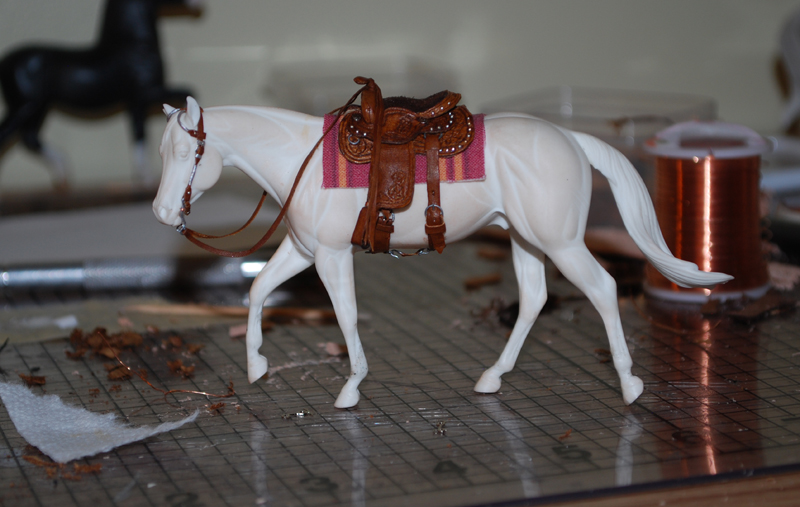
Showing posts with label tips. Show all posts

Reference Photos: Unknown Western Saddle


Yesterday I mentioned my garage sale find of the year: a western saddle for $25. I can't locate a makers mark, but it seems pretty sound. I'll actually be using it for a swing (any interest in a blog post documenting that progress?) but I took the time to snap some photos for anyone who doesn't have one handy or previous experience with western tack.

No matter how much of a Google guru you are, it can be hard to find photos of certain things, like the way the swells are covered and how it's cut for the horn.

Or the shape of the seat...


Or the underside of the fork!


I'm probably a bit biased, but I think the tooling on this saddle is really pretty.


There are more photos of the entire saddle in the Picasa album (click to follow). I tried to cover everything I could think of that might help, but if there's a particular part you'd like to see, let me know!


File Management

I am now the proud owner of a full sized western saddle. I picked it up at a garage sale for $25 with nothing more than a significant coating of dust. I cleaned it up and took a plethora of useful photos that I'm uploading to Picasa as I type, but goodness they're large.

So while those upload, here's a quick post on file management.

Sounds ominous, doesn't it? But trust me, it's not.

When you start collecting reference photos, and it will happen, you need a way to keep them all straight. Sometimes photos of the same saddle are obvious, sometimes not so much. Sometimes its easy to remember the make of  a saddle, sometimes not. So here's what I do.

I have two reference folders, one for finish work and one for tack. We're focusing on tack today.


Within that folder...are sub folders. Lots of sub folders.


I find it extremely helpful to include the name, maker, type of tack and date in the folder name. "Stubben Roxanne", for instance, probably doesn't require a date because it's modern. If it's antique or historical, I'd include it.

In those sub folders, I take advantage of Win8's handy author feature thingy. I'm really sure it was there in previous versions, I've just now noticed it.


I really, really like crediting photographers where possible. It also makes it easier to track them down later if I want to get permission to post the photos or use them in a publication.

At some point, I will probably find it necessary to split my subfolders out. How to split is tough...english saddles don't always fall into clearly defined categories, and neither do western. What I will most likely do is a 'generic' split into english, western, gaited, fantasy, and "other".

You might ask where I get these reference photos...well, I'll cover that next.

Target Wins Again

I love Target. The chic and stylish bedding, the completely and wonderfully fashionable home decor, the clothes that look adorable but never fit (what's up with that, Target?), and the wonderful blend of function and form that is their home storage/office supply area.

I love breezing by the clearance end caps, and here's why:


38 cents. It probably wasn't terribly expensive to start with, but still! $0.38! It's not just any notebook...


It's a file folder! The downside is that those cute little tabs are impossible to write on, so I had to use some sticky labels and trim them down. BUT HEY. It works. I'm using this for pattern storage instead of the index card box. This book fits in better with the other storage items, taking up less room wherever I stash it - desk, shelf, etc. It's maybe not quite as friendly for flipping through, but those accordion sections are pretty generous.

I know it looks spacious, but really - not enough room for an index card box!
Bonus: it actually has a little notebook, and it's removable - and a standard size. I can eventually replace it! It's great for jotting down quick measurements, tack ideas, sketching carving ideas for western saddles...I'm excited, can you tell?


I picked up several of these in different colors, and my Target still had a lot left. If you want one - head over now!

Hard Lessons

I learned some very interesting things while working on my donation to Show for the Cure. Unfortunately, none of them were pleasant epiphanies.  Most of the discoveries were followed by "Oh, crap."

Number one: silver leaf adhesive should probably set really, really well before being sealed. In fact, the sealer sold for silver leaf should probably be used instead of leather sealer. I don't know why, but on the S4TC donation it got tacky and kept sliding around on the pommel after it was sealed. First "Oh, crap" moment. The parade set used a very similar method (I skipped basecoating the pommel in silver paint for the S4TC donation) and is fine. I don't know what happened here, but I'll be keeping an eye on the parade set.

I had two choices: try to fix the bare spots with more adhesive and leaf and reseal (oh yes, great idea), or recover the pommel with leather. That lead to another question...strip the pommel of the fully assembled saddle, try to recover over the silver, or tear the saddle apart and recover it that way? I decided that the chances of glue sticking to tacky adhesive weren't that great and I really did not feel like tearing apart a saddle that used so much Super Glue, so stripping it was. I armed myself with some nail polish remover and pointy Q-tips.

That lead to discovery Number Two: nail polish remover should never be left in plastic bathroom-type cups. Can you guess why?


Yeah. It eats through the plastic. I took a break from picking at the pommel to take the unit test for my intermediate algebra class. I had to get up to keep a cat from playing with something they shouldn't have and when I turned around, I realized that the level of liquid in the cup was considerably lower. I know alcohol tends to evaporate quickly, but nothing evaporates that quickly in a house in February in Kansas. Nothing.

Second "Oh, crap" moment. There was nail polish remover pooled around the base of the cup. The saddle was next to the cup.


The damage was limited to the front part of just one side of the saddle, pretty much what you see here. Nail polish remover also eats through adhesive, though. That's why I was stripping the pommel with it, after all. I'm waiting on the saddle to dry, hoping for no discoloration, and expecting that I'll have to glue the jockey and fender back down at least because the nail polish remover will have compromised the glue. I'm praying that the silver stays intact.

There is a chance that I'll need to tear the saddle apart anyway now. If the leather discolors, I'll have to carve a new jockey, possibly a new fender. The lower skirt, thank goodness, was mostly spared and anything off will be hidden under the jockey/fender.

The irony? In my attempt to avoid tearing down the saddle, I may have created a situation that renders it an absolute necessity.

Hope your day is going better than mine.

It's a Wrap!

The set isn't quite finished. Almost, anyway. But that's not what this wrap is about.

It's about Saran Wrap. Or plastic wrap, if you buy the store brand like I do. Or Evil Forcefield of Staticky Doom if it hates you has much as it hates me.  It sticks to my hands, the counter, the box, itself, and everything but the dish I'm trying to cover.  But I digress.


It's very hand stuff for fitting; protects the model from dye and miscellaneous gunk without creating a lot of extra bulk.  This idea is not mine, lest you think me brilliant or some such nonsense.  Jennifer Buxton and Leah of Shoestring both use plastic wrap to protect ponies while working on various projects.

This lovely Jezebel, resculpted by Mel Miller, is not mine.  Alas and alack.  Let me go weep in the corner for a moment, because she's really lovely and I'm not even an 'Arab person.'

. . .

Okay. Back. If she were mine, I'd skip this step entirely.  Blank resins are not sacred in this studio.  No paint means no problem - I fit directly to the model, wet dye or sealer be darned. WeeJay especially has some epic dye 'sweat' marks, but is tacked up right now (AND my card reader decided to be finicky).

But Jezebel is not mine, and so a great deal of care has been taken with her.  When not in use, she hangs out on a piece of felt on her side, well out of the general carnage.  And when it comes time to fit her saddle, she gets a plastic wrap poncho for protection.


Because I have such bad luck with plastic wrap actually sticking to the desired places, I secured this with a piece of scotch tape under the belly.  It's taped to the plastic wrap, not the pony. The plastic covers more than necessary, actually, since this is just to fit the saddle, but covering the neck and croup helps keep everything in place.

I cover the saddle with sealer top and bottom and then twist tie it down gently.  Too hard and you'll get funky lines across the leather - no bueno. The sealer has two purposes - extra protection for pony down the line and it makes the leather damp, which helps accelerate the shaping process and keeps the saddle in shape after it dries.  Water would accomplish the same purpose, but I like having more than one coat of sealer on a project.  For most of the saddle, this is a second coat. I can be a little flaky with sealing after dyeing and before construction, especially if I'm in a hurry, need just a little bit of this color, or whatever.  That, and the fact that I paint on the studs that go on the jockeys near the pommel, is why I always always seal EVERYTHING at least one more time after I have finished constructing the saddle.


While training the saddle, I do not apply sealer to the stirrup leathers.  I'll do that after it comes off the horse. The stirrup bars (or what would be stirrup bars) are usually covered by the twist tie and cause the stirrup leathers to dry funny.  It's easier for me to do those after the twist tie comes off rather than fighting them.

And viola! Nicely trained saddle, clean pony, win win.


If anyone's counting...10 days until class starts.  Think I can finish this in time?

The Easy Way, Part II

I haven't had the time to make a proper light tent, and my makeshift attempts have all failed miserably.  The light is too warm, too dark, the results too contrasty, the backgrounds horrible.  I am also not a patient (or neat) person (which in hindsight is one of the reasons I make tack this small, I think), so the time it takes to get the tent out, set up the lights, set up the background, take the photos, deal with stickywax that starts to smear under the effects of three or four 65 watt bulbs, and other general problems is not my idea of time well spent.

So I do it the easy way.


When you are photographing to sell, less is more.  A neutral, uncluttered background is best.  The step is deep enough that I can move my horse far enough from the edge to get the wood grain out of focus.  It makes a great background for minis, and that part of the yard is usually in the shade all day, which evens out the lighting and eliminates distracting shadows.  I can't say that the rock garden is terribly comfy, but since I tend to get itchy if I lay in grass it's not a bad deal.  I can run out with my pony, snap the pictures, and head back in; no muss, no fuss, no fidgeting with lights.

Reminds me of the graphics they put on the football field when they broadcast games...the designer in me obsesses over those!
After a little editing in Photoshop (usually adjusting the white balance and a little color correction, all of which could be done in a simpler program), they usually come out something like this -


Sometimes that spot isn't the best choice - it gets direct sunlight in the late afternoon/evening, and the trees in the front yard aren't thick enough to completely diffuse the light in the afternoon.  My alternate is best in the morning, too, actually, but I can usually find some shade with this set up.


Paving stones.  Yes, the two different colors bother me, but since I scrounged for them I'm really not going to complain.  I snapped the photo in bright sunlight just to give you an idea of the arrangement, but I usually photograph this set up in the morning or under the shade of the huge maple that's about five feet away.  When taken under the right conditions, they turn out pretty well.


There's a lot of information out there about taking pictures for the hobby, including a how-to for your own Stablemate size light tent by Leah Koerper of Shoestring Stable and a great comprehensive blog post by Jaime Baker. The basics remain the same photoshowing or selling: even lighting, avoid shadows, focus on the horse.  Obviously the front step is not a solution for anything larger than a Stablemate, but really all you need is a neutral (avoid very dark and very light), uniform surface without major variations in color.

We Can Do It the Hard Way, Or the Easy Way

Fact: the midwest experiences hot, humid summers that start well before the official beginning on June 21.

Fact: sticky wax has a tendency to smudge, smear, and otherwise become useless in hot, humid conditions.

Fact: Sticky wax that won't hold a bit makes it very difficult to set split reins.

So I did it the easy way.


More than one way to skin a cat, right? I can't say that I'd recommend this particular method on a painted horse or nice OF, but on a body or unpainted horse? Heck yes.

Edited to add: Shoestring Stables uses a twist tie (possibly known as a bread tie) instead of bare wire.  What a brilliant idea! The plastic or paper covering provides protection for the horse as long as you don't crank it excessively tight.


In the above photo, I am trying to do a job meant for two hands with one and take a photo of said mayhem with the other.  What I've done is dampened my reins with water and then used that weight to help them drape properly.  I wrap them around the horn to fall on one side of the saddle and let them dry.  When dry, they'll keep their shape fairly well and can be lifted off the horn and placed (with the help of a little sticky wax) in about the same place that a rider would hold them.

Even damp, leather that thin isn't going to have a whole lot of drape to it so I give it a little encouragement.  What works really well? Holding both ends above the horn with one hand and using something round and sort of fat (thin highlighter, thick pen, you get the idea) to give the reins a fairly even drape.

Viola! Draped reins, less headache.


As a side note - the near rein has a little crimp in it, just about straight down from the throatlatch.  This is because I accidentally soaked that rein.  As in, pooling water. I don't recommend that; when they're that wet, attempts at shaping them generally end up looking a little unnatural.  Just let it dry out to damp and try it again.  Or you can work that little bit of rein around in your fingers after it dries, that'll take care of it, too.

Oh, and another note - my reins are sealed after dyeing.  I can't promise that your reins won't spot, discolor, or bleed onto your horse.  As with all things - attempt at your own risk.  (I've never had anything bad happen, though)


There he is in all of his western pleasure glory!

I've worked extra hours at the print shop this week, been to five or six ball games in four days, and had long music practices at church.  I've been going to bed at half-past-exhausted and sleeping later than I'd like.  All of that means that this saddle is almost a week past schedule.  I'm a little behind on other projects and getting frustrated that this saddle isn't just done already.  The pleasure reins were the last thing to make, and I took whatever shots I could while I was waiting for dye to dry this morning.  I'll wrap up the session tomorrow morning and then figure out when I'm going to list this thing on Auction Barn.  I may hold out and list on Sunday, but regardless I'll post notices in all of the usual places.

I have a few topics for posts in mind, if I can get caught up enough to write them! Hopefully I'll be a little bit more of a regular poster now that ball season is almost over.

Sharing is Caring

When my copy of The Babysitter arrived last month, I commented on how large she was and how close in scale that put her to WeeJay.  She was closer than I thought; the two of them can share tack, right down to the bridle and boots!  Because my tack is not adjustable (which makes it easier to put on), each set fits a pretty small range of horses.  In fact, it usually fits just one.


Sometimes the saddle can be passed around pretty easily, but bridles are often quite tricky.  Any time I find two or more horses that can share everything, I get pretty excited.  It means that a sales piece for ________ will also fit _________, which means that it appeals to a wider range of buyers which means that the chances of a sale just went up.

It also means that buyers can get more bang for their buck.  WeeJay is kind of limited to over fences classes, but The Babysitter could tackle a wide variety of events, english and western. With rising prices in the rest of our lives, economizing in the hobby becomes a necessity for most people.  Instead of a saddle for every horse, a set of tack that can go from the CM/AR classes to the OF ring is a great way to cut expenses if you plan to order new gear.

One of my favorite groups of horses to trade tack between is Working Girl/Breyer's WEG Driving Horse.  Working Girl, of course, is no longer in production and actually rather hard  to find second hand, but well worth it if you can.  Sarah Rose's minis hold their value extremely well.  Working Girl and Breyer's WEG Driving horse are both versatile, working models that can be used in a variety of settings.  Because of loose manes, most english flat classes will have to be in lower levels or schooling, but often times fewer moving parts means fewer things to mess up.  A correctly done entry, no matter the level, should always be competitive.

Quite a few of the G3/WEG (G4) models can swap saddles and sometimes bridles, but I have found that in most cases tack cannot be swapped around between generations.  There's a substantial size difference between the G2 (1998) and G3 (2006) molds, and within both generations there's a wide range of head sizes.  The G1s typically have very delicate, refined heads and that is their main problem when swapping tack.  A G2 saddle may fit, but unless you want to do a bridleless reining demonstration you're out of luck.

Resins, of course, are an entirely different ball game.  There's a wide variety of sizes and poses without Breyer and Stone's level of continuity in shape and scale.  Based on the handful I have in my collection, models from Horsing Around and Animal Artistry tend to stay fairly close in scale and are performance friendly. Animal Artistry models tend to run larger than most plastic models, while Horsing Around runs closer in scale to Breyer's G2 molds.

Unfortunately, I can't finish off this post with a comprehensive list of tack-sharing models. It's been a long time since I've had orders for G2 or G1 models, and most of my recent sales pieces have been for the WEG Driving Horse/Working Girl/Little Lonestar trio.  What I DO have is a Google Spreadsheet with measurements for bridles.  I've wanted to do an Equine Resin Directory-like database with tack making measurements for a long time, but it never really got off the ground and I don't have time to put it in a website form right now.  Tack makers and anyone else who needs it are welcome to use the information as reference.  I plan to add more models as I have the time to measure them, and if you happen to have measurements for a model feel free to email them to me! (check out the contact page for my email address)

Model Horse Measurements Spreadsheet

Record Keeping

Keeping records of tack is something that not everyone does.  Some tack makers are so low volume that it just isn't necessary, or they don't expect to become high volume and have nothing set up.  I started out in the second category; I didn't keep records until 2009, and even then my attempts were sporadic and short lived.  It wasn't until 2010 that I started my current digital version.

Keeping a close record of previously made pieces isn't always imperative, but I find it very helpful.  I like knowing what I've made in the past, and if a customer needs a repair or replacement part, it's especially nice to know what kind of dye I used.  Not only is it great to keep the details of each order straight, records are also extremely helpful when dealing with deposits and time payments.

My first attempts at record keeping were aimed at finding a way to gather the pertinent information about an order in one place.  I cycled through an index card and binder system before settling on Microsoft Excel.  Excel and similar programs like Google's Spreadsheets are useful for a variety of reasons.  Information can be sorted via filters, easily changed, and tabs make it easy to keep track of different sections of your hobby endeavors.  It also made it much easier for me to be consistent with the information I took down, as well as keeping track of non-commissioned pieces.

Excel is part of Microsoft's Office Suit and does not come standard on Windows machines.  If you don't want to buy a program, there are alternatives like Google Spreadsheets and OpenOffice.org.  I have used Google Spreadsheets for other projects and really like it, but am hesitant to use it for tracking orders.  The great thing is that it can be accessed from any computer, and that's also my concern.  Spreadsheets can be marked as private, but I still worry about hackers.  The most sensitive information I keep in my spreadsheets are email addresses, but I don't want some unsavory person getting into any of the information I have on there.

The information I include in my spreadsheet has evolved over time and is still evolving.  I have tabs to keep track of current orders, finished pieces (which includes finished commissions, donations, sales pieces, and personal projects), and accounting.  Instead of just keeping the details of an order straight, I'm also tracking the numbers made, how many times a customer comes back, when certain things were finished, and even trends in dye and style.  Don't forget the accounting possibilities with Excel and other spreadsheet programs!

Here are two screen shots to give you an idea of how I have this set up.  Click on the photo to view larger. Some information has been removed or fabricated to protect the innocent.

The first screen shot is of my tack log.  I track finished pieces here whether they're sales, orders, donations, or personal pieces.  Items are added to this sheet after they are completed.  In the past I only tracked orders and donations, but when I closed my books it became more important to track all of my work.

The sheet is pretty self-explanatory.  Each item has the date of completion, what kind of transaction (donation, order, sales, or personal), the style or discipline (style was shorter), details about the order, price, buyer information, and notes which might be about the transaction as a whole, special information about the tack, etc.

Originally the "details" column included what mold(s) the set was fitted to and what dyes were used, but when I redid my Excel file at the beginning of the year I split those out so that I could track trends more easily.

This second screen shot is of my orders page.

As a rule, I track only time sensitive projects in the Current Projects tab, though I think I had planned to include personal projects and sales pieces at one point.  Instead, I keep tabs only on donations and commissions.  Most of this sheet is set up like the Tack Log sheet, so that when an order is finished I can copy and paste information from one sheet to another.  In the past I included information like buyer's address and the date the package arrived, but that information was difficult to place into Excel in standard form (addresses) or moot once the project was moved to the Tack Log tab (arrival date).


I hope this post is somewhat helpful; I always feel a little out of my depth when I write informational pieces for this blog.  Comments are welcome, as always, and so are topic suggestions!


Tips, Tricks, and Various Bits of Information

Just a quick something while I continue to plug away at class work and the edited version of the saddle tutorial.  Hope you find some useful info in here!  I may be able to expand some of these topics into full posts later, so if there's something you'd like to see more of, let me know!

Reference Material
My favorite book is The Essential Book of Horse Tack & Equipment.  It's primary focus is on english tack, but it's got great information on bridles, bits, gadgets, martingales, saddles, boots, you name it.  The photos are awesome, the diagrams are great, but the best part is the information on fitting and the thought processes behind it.  I love knowing the 'why', not just the how or what.


A great online resource is used saddle listings.  They usually show photos from a lot of different angles, including both sides, the top, and underside.  You do want to be cautious and make sure that you're using a quality saddle as your reference, though.  If you're unsure, a quick search with the brand name of the saddle will help shed some light on the quality.

Tack catalogs can be extremely useful, both hard copies and online.  Dover Saddlery and State Line Tack are the two that come to mind first.

Organization
I have the neat freak gene from my mom and the pack rat gene from my dad.  I like things to be neat, tidy, and organized but it's easy for me to squirrel things away willy-nilly when I'm stressed or tired.  I found that a really good way for me to combat that habit is to keep as much stuff as possible in clear containers within easy sight.  I'm less likely to pick a box and shove something in it if I have a visual reminder of what actually belongs in that box.

I have half a dozen or so rectangular bead containers from Hobby Lobby that I love.  Those are great for storing spools of wire, hardware, jump rings, beads, and are great tack boxes for Stablemate stuff.  You can get half-size ones in Walmart's crafting department, too, which works even better for me.  Here's a photo of the two I'm in the most often.


The most-used supplies live in the one on the left.  I've got silver wire, thread for raised bridles and saddle piping, stirrups, bits, chain, and metal embellishments & crystals.  Extra blades for the snap-off & Exacto knives live in the long middle section.    The case on the right holds extra silver wire as well as copper and gold.  Miscellaneous traditional and classic scale hardware lives in there too, along with some glue I never use, foil for western saddles, and metallic thread.  (I had to tidy these things up before I showed you guys! I would have felt like a hypocrite otherwise, haha)

Anything you use a lot should be in easy reach.  Glue, tools, and toothpicks live on the far right side of my desk.  Not only because I'm right handed, but because that's "dead" space that I can't work in very easily.


I've mentioned them before, and I'll say it again: Dixie cups are amazing.  I tuck all of the little bits and pieces of a project in it's own cup and use alligator clips and pushpins to keep them out of the way.  If there are enough projects going, each cup has a masking tape label added to it.

Little Tricks
Use glue as an alternative to gum tragacanth for smoothing down the fuzzies on the edge of cut leather pieces. This should be done after dyeing your leather.  Use a tooth pick to spread a bit of glue on the edge and fuzzy side.  Shape it with your finger or the tooth pick and let it dry.


To cut even pieces of lace, I lay a strip of double sided tape on my cutting mat.  Line your leather up with one of the guides on the mat and stick it down.  I use and Exacto knife and even up the top edge first, then cut my strips out.  I use this method for pretty much everything that requires straps.  Stirrup leathers, bridles, reins, breastplates, you name it.  It's best if you work with leather that you've already thinned, but you can thin each strap individually, too.  Dyeing is a toss up; the Eco-Flo dyes don't seem to absorb all the way through the leather, so I always have to go back and redo the edges.  It would probably be just as easy to dye after I've cut the straps.


Buckle Free Tack

A quick note before we begin: this post makes a lot more sense if you know what to call the parts of an english bridle. Wikipedia has an excellent description, sadly without a picture.  In a swift Google search, I didn't come up with anything better.  Now, on to the post!

The primary objective of buckle free tack is to preserve the appearance of working buckles while eliminating the stress they can cause.  This is really only effective at Little Bits or smaller scales, but is almost necessary with Stablemate or micro mini models.  Working buckles come in two forms: tongue buckles or slip buckles.

Slip buckles on the left, tongue buckles on the right
In real life, of course, all buckles have tongues and the shape varies depending on the type of tack.  In the model world, slip buckles refers to buckles without tongues at all.  They are usually quite functional, though not quite realistic.  Tongue buckles are truer to life, but can be harder to handle.  In Stablemate scale, the majority of adjustable tack will have slip buckles.  The use of tongues on strap goods is so frustrating as to be worthless, though I have on occasion done it (see photo above!).  In addition to the frustrations of actual use, already thin leather is substantially weakened by the small holes necessary for adjustment.

I have found that there are several frustrations with slip buckles in Stablemate scale.  For one, they slip! It can be difficult to get things to stay put as you are adjusting them, especially if the leather slips all the way out of the buckle.  Another frustration is the necessary thinness of material that comes with scale.  Buckles made out of 32g wire (like the gold ones above) are prone to bending out of shape and in some cases coming loose entirely.  Repeated use of straps causes wear, and with already thin leather each use makes it more difficult to thread the leather back through the buckle.  With enough use, straps will eventually break.  Keepers, small loops of leather that keep excess length from flapping around on bridles, breastcollars, and virtually every form of strap good available, are often left off for convenience.  No one wants to mess with a keeper after spending 10 minutes getting a strap back through it's buckle.

The pro of adjustable strap goods is, of course, being able to adjust them to fit a variety of models.  In 2008, I was convinced that the sheer usefulness of adjustable tack outweighed the headaches it caused in the making and tacking up.  It was gently pointed out to me that tack with faux or fixed buckles was highly appreciated by customers and, in the long run, much easier to use and make.  I am a stubborn sort of person, but eventually I realized that they were right.

When you fix the buckles on a piece of tack, you must either leave it on the model permanently or find some other way of getting it on and off.  That particular piece of tack will (in most cases) fit that one model exclusively.  If you are lucky, there are other models similar in size and shape that can share.  Molds within a generation of stablemates will often be able to share tack, but not always.  The G3 cantering warmblood is almost identical to the jumping horse, but their forelocks are different sizes, so they can't share.

Western bridles and western and english breastplates don't usually require any special on/off mechanism.  Without a browband, noseband, or throatlatch western bridles slip over the head easily.  Breastplates slide over the head neatly, too, and don't need to be split anywhere.

English bridles or bridles with a throatlatch and noseband require creative thinking.  The key thing is to hide the way you are securing the tack so convincingly that it takes a great deal of effort to locate it.  I have seen two primary methods used to accomplish this:


  • The cheekpieces and cavesson are fixed, while the throatlatch and noseband are loose and stickywaxed out of sight. The throatlatch has a faux buckle, while the noseband is often buckle-less.
  • The cavesson buckles are fixed and the cavesson is separate from the headstall, stickywaxing behind the ears somewhere and hidden by the crown.  The throatlatch must also stickywax under the crown, which often ends up being under the corner of the browband.
There are often some minor differences within each method, but that's the short of it.  In the first method, it can be difficult to get the noseband to sit correctly, especially if the stickywax isn't cooperating.  I've also found that it's not always easy to tuck the throatlatch up under the crown without something popping loose.  The chances of something slipping increase with each spot you have to stickywax, too.  I've used both of those methods, and eventually abandoned them for one of my own.  

When I make a fixed bridle, I begin with the cavesson.  When completed, it's put on the horse and buckled down with a bit of glue near the actual buckle to hold it in place.  The cheekpieces and headstall are made next.  The crown of the bridle is glued to the top of the cavesson and everything is buckled and glued.  The browband is glued to the headstall at the proper place, with ends left loose to wrap around in just a minute.  Now that the bridle is finished, I make a careful cut on one side of the browband.  Here's a bad photo that makes a good illustration.


The stickywax wasn't cooperating that day, and the browband popped loose from it's spot.  You can see where I made the cut, though, and when everything is fastened down properly it's not easy to spot.  Unlike the other methods, there's only one spot to stickywax and you don't have to worry about ear rubs.

In some cases, going buckle free means literally that: no buckles.  English girths are an excellent example.  It's far easier to stickywax the girth under the saddle flap than fuss about with buckles, which usually add bulk.  I like to glue both ends of the girth under the flap and then split it across the middle so that it stickywaxes under the horse's belly.  This would never work on a Traditional or Classic model, and I would probably avoid it on a larger Stablemate and Little Bit models.  In most cases, Stablemates are low enough to the table that a judge would never notice.  

Western cinches are the one place I retain working buckles.  It's true to the real piece of tack, can be accomplished in scale without excessive fear of damage, and isn't that hard to use.  

I hope this has been informative, and that I haven't rambled too much.  Feel free to leave questions, and I'll do my best to answer.


I Think I'm In Love

This stuff was recommended to me highly.  I was curious, so when I happened across it at Michaels a few weeks ago I picked it up.  I didn't have time or a project to try it on at the time, but I tested it today.

I don't think I will EVER go back to sticky wax for boots.  This stuff is just as easy to find as sticky wax, and yeah, it's not reusable and you will have to reapply eventually, but the headaches it saves are SO worth it.  I threw some of it on the sport medicine boots I made this morning, and my eyes got big when I actually started tacking up.  It's amazing! The little tabs just stuck and I didn't have to worry about them popping off or anything.  Definitely worth the $4 or $5 a bottle, and I'll be using this stuff as often as possible.

Oh, here are the boots! They sit SO well with the Tack-It glue.


I've got a few other things I love, too, like my craft knives.  I use a small snap-blade knife for skiving and a regular exacto for everything else.  I can't imagine living without them.  The body of the snap-blade knife is old old old, from Walmart.  They no longer sell these knives or the blades, but you can pick them up near the paint/wall paper supplies at stores like Lowes and Home Depot.  I think the Exacto brand has one too, but I found the home improvement stores to be far less expensive than buying the name brand knife or blades at a craft store.

It's far easier to make your own buckles and most of your own bits when working in Stablemate scale.  I use 26g, 28g, and 32g wire.  26g is reserved for bits, western saddle rigging, or reinforcing various parts, like the swells and horn of a western saddle.  I also used it for stirrups, but less so now. 28g wire is often used for buckles or smaller D and O rings and as tongues for buckles made out of 26g wire.  32g is used to create the mouthpiece on bits (which is why I also have copper; it looks spiffy on western bits), and fixed buckles.  It's too thin to do anything else with, really.  Also in the photo is a spool of nylon upholstery & home decor thread.  It's thicker than the usual cotton stuff.  I use it in raise nose and brow bands, since wire can sometimes poke through the lower lining.  It can be very useful on english saddles, as you'll see when the english saddle tutorial is finished!
Back: 26g.  L to R middle: 28g, 32g silver, 32g copper. Front: upholstery thread. 

I only use two pairs of pliers, and one kind of snip.  I do have two pairs of the snips, though.  The tips get worn down and pitted eventually, so the worn pair is retired and used on rough stuff like straight pins.
If I could find a smaller tip on the round and needle nose pliers, I'd love it.  I haven't seen any at Hobby Lobby or Michaels, so I should probably do a little hunting online.  What I have works, though.


So, there's another look at the stuff I use.  Questions and comments, especially suggestions for walk-throughs and tutorials, are always welcome! 

Don't forget, everyone, 19 more days to enter the raffle! Every post is another entry into the raffle.


Things I Can't Live Without, Part One

Everyone, no matter what part of the hobby they're involved in, has at least one hobby-related something they can't live without.  As a tack maker, I have quite a few somethings, so I'm going to share a couple! 

Mini Clothespins
Okay, so this one isn't new to most people.  In fact, it's pretty obvious and already used a lot by other tack makers.  Me? I discovered them exactly three weeks ago.  I can be a little slow on the uptake sometimes.  They're perfect for holding pieces together while glue dries.  I'm sure there are other uses, too, I just haven't found them yet.


Sharp Pointy Objects
Needles, straight pins, and my personal favorite: a random sculpting tool that I bought from a garage sale.  It's got a stiff metal rod in a wooden handle that's pretty comfortable.  Probably through misuse, the very tip is slightly bent.  This is actually hugely helpful, since it makes a slightly larger hole than might otherwise be expected. It's great for punching holes for fake buckles, stitch marking, and removing any excess glue that might seep out.  Needles are pretty obvious: good for lacing reins and any other sewing.  Tip for lacing reins: turn your needle so that the eye opening is perpendicular to the lace, so that there's less stress on a narrow part of the rein.


Scissors
I only use one pair of scissors and I've had them so long it's unbelievable.  Slightly larger and definitely more pointy than school scissors, they're the perfect size for the leather I work with the most.  They don't handle thicker leather very well, but that's okay.  I sharpen them periodically with scissor sharpeners and pray that I never lose them, because I haven't seen a pair like this in years.


Product Review: 1:32 Scale Stirrups


When I started the new year one of my goals was to improve my tack as much as possible. One of the ways I planned to do that was to use cast or photo etched parts where those would be more realistic. I use various gauges of wire for nearly everything. 32, 28, and 26 gauge wire meet most of my needs. There are times when making my own hardware falls short, though. Some bits are just too darn hard to make out of wire. Driving bits and western curb bits often fall under this category, and stirrups are not easy to do! So far I've used stirrups from Sulser Saddlery and Horsing Around (based in the UK). I'll be comparing the two brands based on scale, price, and material.

Stirrups will be shown on Breyer's G1 Seabiscuit, G2 Warmblood, G3 Thoroughbred, G4/WEG Dressage Horse, Stone's Chip Stock Horse, and the Working Girl artist resin sculpted by Sarah Rose for scale comparison.

Sulser Saddlery
Material: white bronze. Sculptor: D'Arry Jone Frank. Price: $6.99 (TWMHC Ebay Shop)

Sulser Saddlery is an immediately recognized name in the model horse world. In stablemate scale they offer stirrups and a few cast bits sold through The World of Model Horse Collecting's Ebay shop. The stirrups were sculpted by D'Arry Jone Frank who does a lot of wonderful work in smaller scales. I have never purchased directly from TWMHC. In the past, I have received hardware in trades or from my customers who would like it to be used on their tack. In a couple of instances, it was shipped directly to me from TWMHC, though paid for by my customers. Shipping seemed prompt, from what I can remember, but it's been a while.

According to the Ebay listing, the "silver" stirrups are cast in white bronze. The pair I have in my studio has been with me for several years (probably since 2007), attached to a saddle and stored away most of the time. They arrived bright and shiny but have taken on a darker, dull color with age. A little bit of polishing with the hem of my t-shirt did a lot to bring back the shine, but a silver polishing cloth would be more effective. The need to clean them up periodically could be awkward if they're attached to a saddle or, worse yet- the saddle were permanently attached to a model. They don't come with sculpted stirrup pads, but it would be entirely possible to paint them on or glue a thin piece of white or painted leather down instead. I would recommend Eileen's Jewel-It or Super Glue Gel if you were interested in trying that.

I was not thrilled with the shape of these stirrups. They seemed rather triangular compared with the soft curve found on real stirrups. To my eye, they are also on the small side. I have often heard that Breyer's G2 run of models were not true 1:32 scale, being larger, and they've increased in size since. It's very possible that the stirrups are actually sculpted in 1:32 scale, which would make them a little too small for most models. In my comparison, I found that they looked best on G2 molds, passable on G1s, and weren't very well suited to any of the other molds I tried.


Horsing Around (UK)
Material: "White metal". Sculptor: Horsing Around Tack Shop. Price: GBP 1.95/$3.15 (Horsing Around UK Ebay Shop)

I found these stirrups when I was researching my options at the beginning of the year. The price was appealing, but I wasn't sure how the scale matched up. I shot an email off to Horsing Around, requesting photos and a little more information. Given the time zone difference, I feel the response was prompt and the person I spoke to, Vanessa, was nothing but wonderful! She provided photos, shipping cost information to the US, and answered any other questions I had. I ended up purchasing directly from Horsing Around instead of through their Ebay shop. This resulted in a slight discount, since they didn't have to pay Ebay fees. My stirrups shipped on the 24th and arrived the same week.

These are cast in "white metal". I'm not sure exactly what type of metal that is, but it feels pretty lightweight, possibly lighter than the Sulser castings. I don't know how this metal will hold up over time, but I'll be updating this blog when I find out. There is some texture and exposed seams on the stirrups. I'll be cleaning up the seams a little with an Xacto knife, but I don't know that the texture is enough to bother me. These stirrups don't have the mirror smooth finish that Sulser castings do, but there's still plenty of shine.

I find the shape of these stirrups much more realistic than the Sulser casting. They're much rounder and to me more like a real stirrup, like these from Dover. Like the Sulser casting, these don't have sculpted stirrup pads. You could paint them on or glue down a piece of leather if you really wanted to. I actually think the glue method would work better on these stirrups because of the slight texture.

These stirrups are a little bit larger than the Sulser castings and seem more in scale with the models I tried them on. I especially like the way they look on the Chips Stock Horse, Working Girl, and the G3/G4/WEG molds. They look pretty good on the G1 Seabiscuit, but maybe a little big on the G2 Warmblood. Overall, I find the fit better than Sulser.


RDLC (Rancho De Los Caballitos)
Material: Gold plated. Sculptor: RDLC. Price: 7.99 (TWMHC Ebay Shop)

I haven't used these stirrups myself. I'm mentioning them here because they're the only other option for cast stablemate stirrups that I can find on Ebay. From the photo in TWMHC's Ebay listing, they look small and bulky. I can't say for sure since there's nothing in the listing photo to suggest a size. According to the listing, experienced tack makers will find this artists work to be the best on the market. Maybe the stirrups look better in person. I've had that happen several times with saddles. They look great on the horse, but you take a picture and somehow it loses something. The gold plated stirrups were the only ones available at the moment, but I have a feeling that whatever the regular "silver" color is they'll be a bit cheaper. The western stirrups by RDLC were $5.99, so that would be a safe bet for these stirrups as well.


Conclusion


I'll be using the Horsing Around stirrups for my projects from here on out. I ordered 10 pairs, enough to keep me in business for a few months at least. The texture does not thrill me, but it's something I can live with when I compare the shape and scale compared to Sulser's castings (and price!). As I experiment with the Horsing Around stirrups, I may find that the texture will buff out with some work, we'll see.